

Have a sore right now? Get it swabbed today.
Same-day HSV PCR in Houston — walk in, no appointment, no insurance, no referral. Up to 40% less than urgent care. Results at 4:30 PM; if treatment is clinically appropriate, a licensed physician from our partner network sees you 4:30–6:00 PM.
Same-day HSV PCR in Houston — walk in, no appointment, no insurance, no referral. Up to 40% less than urgent care. Results at 4:30 PM; if treatment is clinically appropriate, a licensed physician from our partner network sees you 4:30–6:00 PM.
3707 Westcenter Dr Suite 100, Houston, TX 77042 · Mon–Fri 9:00 AM–5:00 PM · Sample by 1:00 PM · Your slot with the doctor is held when we take your sample
Medically reviewed by our MD Laboratory Director (a role required by CLIA; the director’s name is on file in the CMS CLIA database, #45D2048957, and can be verified independently) · Editorial policy
Oral herpes (usually HSV-1) begins with tingling or burning before anything is visible, then a cluster of small, clear, fluid-filled blisters on a red base — most often at the border of the lip. The blisters break, weep, crust over, and heal in roughly 8 to 12 days without scarring. The clustering is the tell.
Have a sore right now? Swab it today while it is fresh — a lesion PCR is the most reliable herpes test there is, and it loses sensitivity as the sore crusts over.
📱 Text (713) 832-8892
📞 Call (713) 266-0808
📱 Text (713) 832-8892
📞 Call (713) 266-0808
3707 Westcenter Dr Suite 100, Houston, TX 77042 · Walk-ins welcome
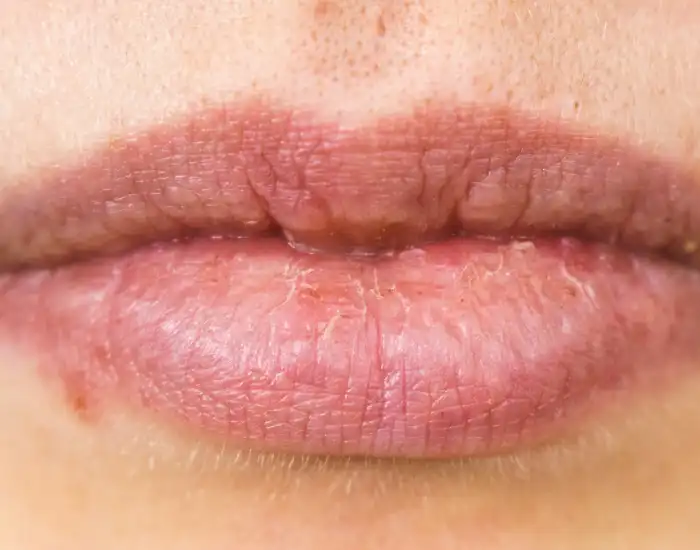
What each stage looks like
| Stage | What you see and feel | Typical timing |
|---|---|---|
| 1. Prodrome | Tingling, itching, burning — nothing visible yet | Hours to a day before the sore |
| 2. Blister | A cluster of small, clear, fluid-filled blisters on a red base | Day 1–2 — best day to swab |
| 3. Ulcer | Blisters break open into shallow, painful, weeping sores | Day 2–4 — most contagious |
| 4. Crust | A yellow-brown scab forms; it may crack and bleed | Day 4–8 — PCR becomes less sensitive |
| 5. Healing | Scab falls away; pink new skin underneath; no scar | Day 8–12 |
The one detail that separates herpes from nearly everything else: it is a cluster. A single isolated bump with a white head is almost always something else.
What it is not
| Look-alike | How to tell it apart |
|---|---|
| Pimple | Single, white head, on the skin — not clustered, no tingling first. Side by side |
| Canker sore (aphthous ulcer) | Inside the mouth, on soft tissue; round, white-grey with a red rim. Herpes prefers the lip border and hard palate |
| Angular cheilitis | Cracking at the corners of the mouth; often fungal |
| Impetigo | Honey-coloured crust; bacterial |
Do not accept an HSV IgM blood test. CDC does not recommend it — it produces false positives and a great deal of unnecessary panic. If there is a sore, swab the sore. See lesion PCR vs. antibody testing.
We name drugs, never doses. Antiviral therapy for HSV follows CDC guidance; what you actually take is decided by a licensed physician who has examined you.
The single most useful thing on this page. If you have a sore right now, get it swabbed today — lesion PCR identifies HSV and tells you whether it is HSV-1 or HSV-2. Sensitivity falls as the sore dries and crusts, so the best day to test is the day it appears. Sample by 1:00 PM → result at 4:30 PM → if treatment is clinically appropriate, a licensed physician from our partner network sees you 4:30–6:00 PM. Same day. Walk in, no appointment, no insurance. Text (713) 832-8892.
FAQ
- Is oral herpes an STD?
- HSV-1 is extremely common and most people acquire it in childhood, non-sexually. It can, however, be transmitted to the genitals through oral sex — see oral sex and STD risk.
- Can I test if the sore is already crusted?
- You can, but sensitivity falls as it dries. Come in today rather than tomorrow — and we will tell you honestly if the swab is unlikely to help.
- Should I get a blood test instead?
- If you have a sore, no — swab it. Blood tests tell you about past exposure, not about the sore in front of you. And CDC does not recommend IgM.
- Can it be treated?
- Antiviral therapy reduces outbreaks and transmission. A licensed partner-network physician decides what is appropriate — same day, 4:30–6:00 PM.
The sore will crust over in a few days — and the test gets less reliable as it does.
Walk in today. Result at 4:30 PM. Licensed partner-network physician 4:30–6:00 PM if you need treatment. No appointment, no insurance — Save up to 40% compared to urgent care.
📱 Text (713) 832-8892 — fastest
📞 Call (713) 266-0808
Walk in today. Result at 4:30 PM. Licensed partner-network physician 4:30–6:00 PM if you need treatment. No appointment, no insurance — Save up to 40% compared to urgent care.
📱 Text (713) 832-8892 — fastest
📞 Call (713) 266-0808
3707 Westcenter Dr Suite 100, Houston, TX 77042 · Mon–Fri 9–5 · Walk-ins welcome · CLIA #45D2048957 · CAP #8722734